Lifelong learning for Leoncie
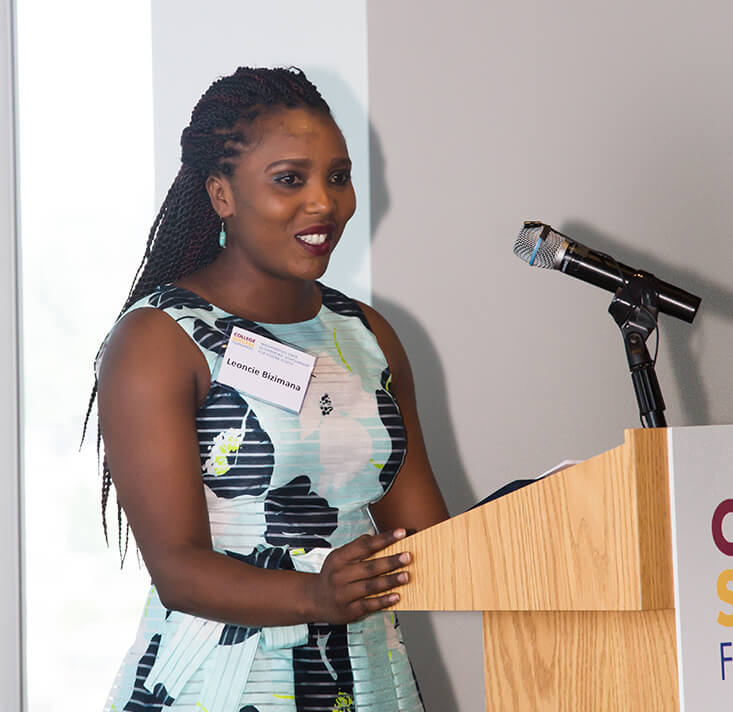
Former refugee Leoncie turned a difficult past into a drive to help others.
Leoncie always loved school. But her childhood in the Democratic Republic of the Congo was marked by violent political unrest, and her schooling came to a halt when she and her older sister fled for their lives when she was just 13.
Leoncie and her sister spent several months seeking refuge, passing through Uganda and Kenya before arriving at Sherkole Refugee Camp in Ethiopia. The camp became her home for the next year, but it offered none of home’s familiar comforts: She was assigned a mud hut without a bed or a stove and survived on meager daily rations of sorghum, a cereal grain.
At Sherkole, Leoncie was surrounded by people in dire need of health care.
“We had little water or food and no access to health care or hospitals,” she said. Without medically trained personnel to help, refugees, including children, died every day, she said.
Hope for the Future
In this harsh environment, education held hope for the future—with medical training, she would be able to help people like those she saw suffering in the refugee camp. “I thought, I end up surviving and if I have the chance to go back to school, I would go into the nursing field,” she said.
But first she had a health crisis of her own. By 15, Leoncie developed anemia so severe that she had to be transported out of the refugee camp to a hospital in Ethiopia’s capital city of Addis Ababa, where she struggled to regain her health over the next year.
Once she was healthy enough to travel, she learned that she and her sister had been matched with a foster family in the Seattle area.
Working Toward her College Dream
When the 17-year-old arrived at SeaTac Airport, tired and jet-lagged, she had one wish: to attend school. “I wanted to attend a university and become an educated woman,” she said. She soon learned she’d first need a high school diploma, and within a week, she started classes at Seattle’s Franklin High School. But her classes proved frustrating, because she knew so little English that she couldn’t understand her teachers or classmates.
So she threw herself into learning the language, studying four to six hours after school with the help of books and her caring, supportive foster parents. Within a few months, she understood enough English to keep up in class; after petitioning her school principal, she moved up a grade level from first-year to sophomore classes. She worked diligently toward high school graduation and her ultimate goal of attending college.
As a senior, Leoncie began applying to college and searching for scholarships. The first scholarship acceptance letter she received from College Success Foundation for the Governors’ Scholarship for Foster Youth. Opening the letter, she felt a sense of calm, she said.
“I knew I could go to school and continue my education. It gave me hope.”
Adapting to Campus Life
Leoncie was admitted to several universities and chose Washington State for its nursing program. She was elated—finally, she’d achieved her long-held goal of enrolling in a university. But transitioning from high school and her warm, welcoming foster home to a sprawling, unfamiliar college campus held unexpected challenges, like communicating with an entirely new roster of professors and adjusting to their varying teaching styles.
As Leoncie adapted to campus life, her CSF Passport Navigator offered vital support and counseled her on how to approach her professors with questions, access university resources, study for exams and plug into social clubs. This support helped Leoncie, still shy about her English, find her voice in class.
“My Navigator had experience as a college student, and she showed me what I could do to impact my grades,” she said. “She showed me how to ask questions and go directly to the professor when I needed more information.”
Connecting with Foster Youth
As she prepares to enter WSU’s nursing program in the fall of 2017, Leoncie hopes to connect with other foster youth with similar dreams and goals, possibly as a Passport Navigator herself. “Even if you haven’t had the same life, you can still inspire one another,” she said.
Refugees and foster youth may have obstacles to college, but they shouldn’t give up, she said. “I want to help them be strong and no to be afraid of college. It is hard, but it’s manageable.”